

Wedding date Selection (看日子)
In traditional Chinese culture, the first step is the selection of auspicious dates for the wedding (to assure a good future for the couple), the betrothal, and the installation of the bridal bed. A suitable date is selected based on the couple’s birth dates and times. Some people may also refer to the Chinese calendar for good days. Even numbered months and dates are preferred. The lunar seventh month is avoided as it is the month of the Hungry Ghost Festival.
Gift giving (過大禮)
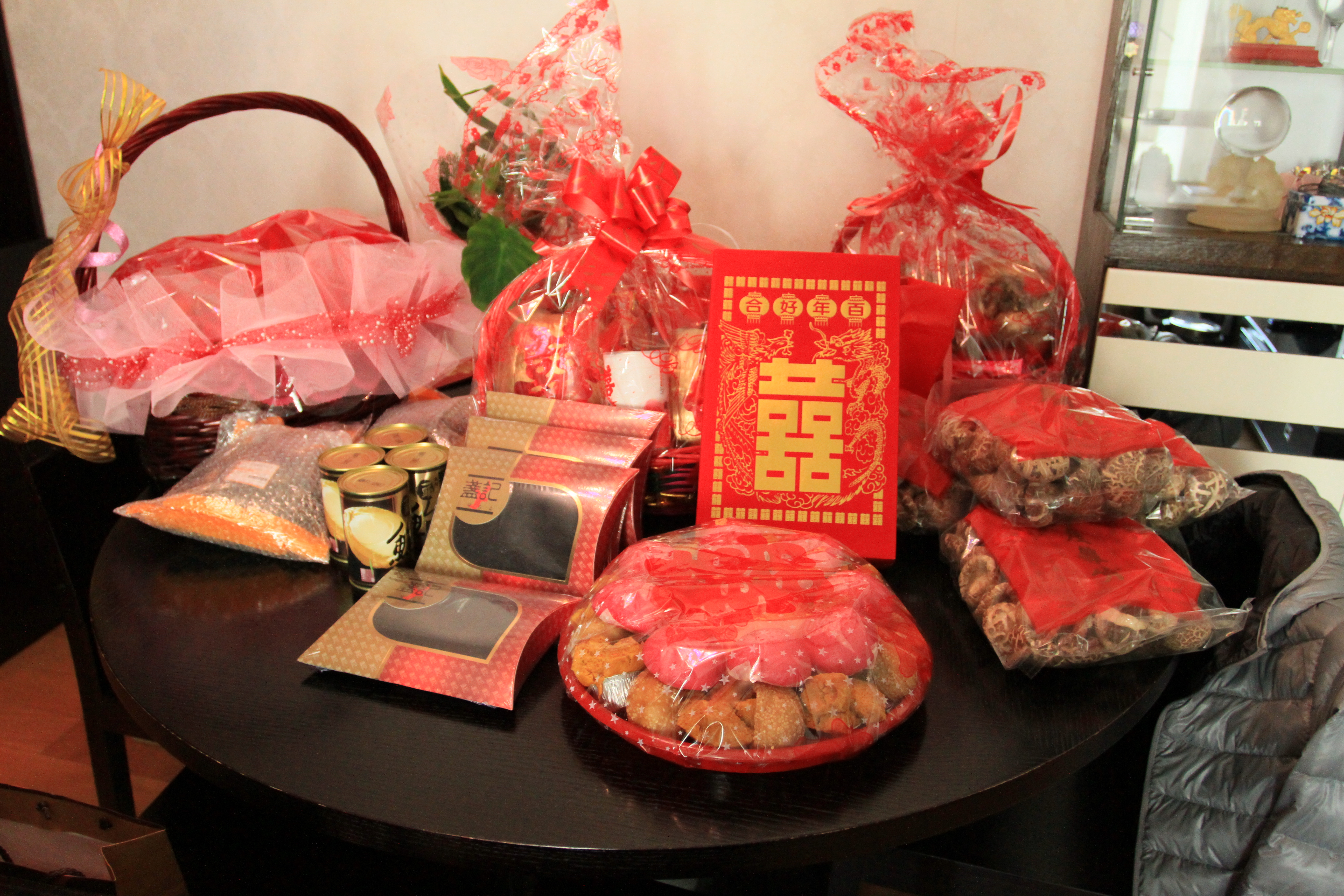 The groom and his family are financially responsible for the entire wedding. Wedding details like types and quantities of betrothal gifts, reciprocal gifts, bride price (money given to the bride’s family in exchange for their daughter), and number of guests are discussed and negotiated with the bride’s parents.
The betrothal is an important part of the Chinese wedding tradition. During this exchange, the groom’s family presents the bride’s family with gifts to symbolize prosperity and good luck. The gifts are often in even numbers to symbolize that the couple will forever be “a pair” and together. “Double joy” is a word which is often seen in Chinese weddings. Double joy stickers and papers are placed on wedding items, betrothal gifts, mirrors, cupboards, doors, and other items and places around the home.
Upon receipt of the gifts and money, the bride’s family returns a portion of it to the groom’s family.
Attires and Rituals
The bride wears an embroidered red silk dress, or an embroidered red coat with a long red skirt. The groom’s family is expected to give a pair of matching gold “dragon and phoenix” bracelets to the bride. The bracelets are to be worn at the wedding as the dragon and phoenix symbolize a union.
接亲 (taking of the bride) is a traditional Chinese ceremony which is the process of going to meet one’s bride at her home before escorting her back to one’s own home for wedding. At both places there is the Tea Ceremony which is the equivalent of exchange of vows at a western wedding ceremony.
When the groom arrives at the bride’s house to pick up the bride, the groom and his groomsmen are met by the bridesmaids and close friends/relatives of the bride. The ladies would require the guys to do all sorts of challenging and silly things (ie. drinking soy sauce, completing 30 pushups in half a minute), and to give them red pocket money before the ladies “release” their friend- the bride- to the groom.
For wedding guests, unless there is a wedding registry, it is customary to give the couple a gift in the form of cash. The cash should be in a red envelope and is given upon check-in at the restaurant. In choosing the amount of money to give, unlucky numbers (ie. number 4) are avoided.
 Tea Ceremony
The tea ceremony is the most significant event in a modern Chinese wedding. The tea ceremony is an opportunity for the bride and groom to express gratitude towards their parents for looking after them until the wedding day. In Chinese families, one is considered an adult and independent when one gets married. This also serves as the event during which the family meets the new spouse and welcomes him or her to the family.
Wedding Banquet
The banquet is sometimes considered more important than the actual wedding itself. It entails various ceremonies, like the tea ceremony, in which the couple serves tea to their parents and other elders in the family. Wedding banquets are elaborate and typically consists of around 10 courses. Foods like shark’s fin, abalone, lobster, roasted pig, and chicken are commonly seen on the menu. A whole fish, chicken, or pig means luck and completeness in the Chinese culture. Wedding banquets are a gesture of thanks and appreciation to those who have raised the couple. Hence, out of respect for the elders, the banquets are usually done formally and traditionally.
On the third day following the wedding, the bride will return to visit her family for the first time. A red banner is hung across the front doors of the two households to announce the joyous event. While the bride is now a member in her husband’s home, she is considered a guest in her parent’s home.
We are not following the traditional Chinese marriage practices. Instead, we will be combining elements of a Western Christian wedding with Chinese customs. This vastly simplifies the wedding process and a lot of traditional practices would be considered inappropriate for this day and age. However, we feel the need to pay homage to our roots and so here are examples of traditions that we will follow:
- Gift Giving (過大禮)
- Taking of the Bride (接亲)
- Tea Ceremony
- Chinese Wedding Banquet